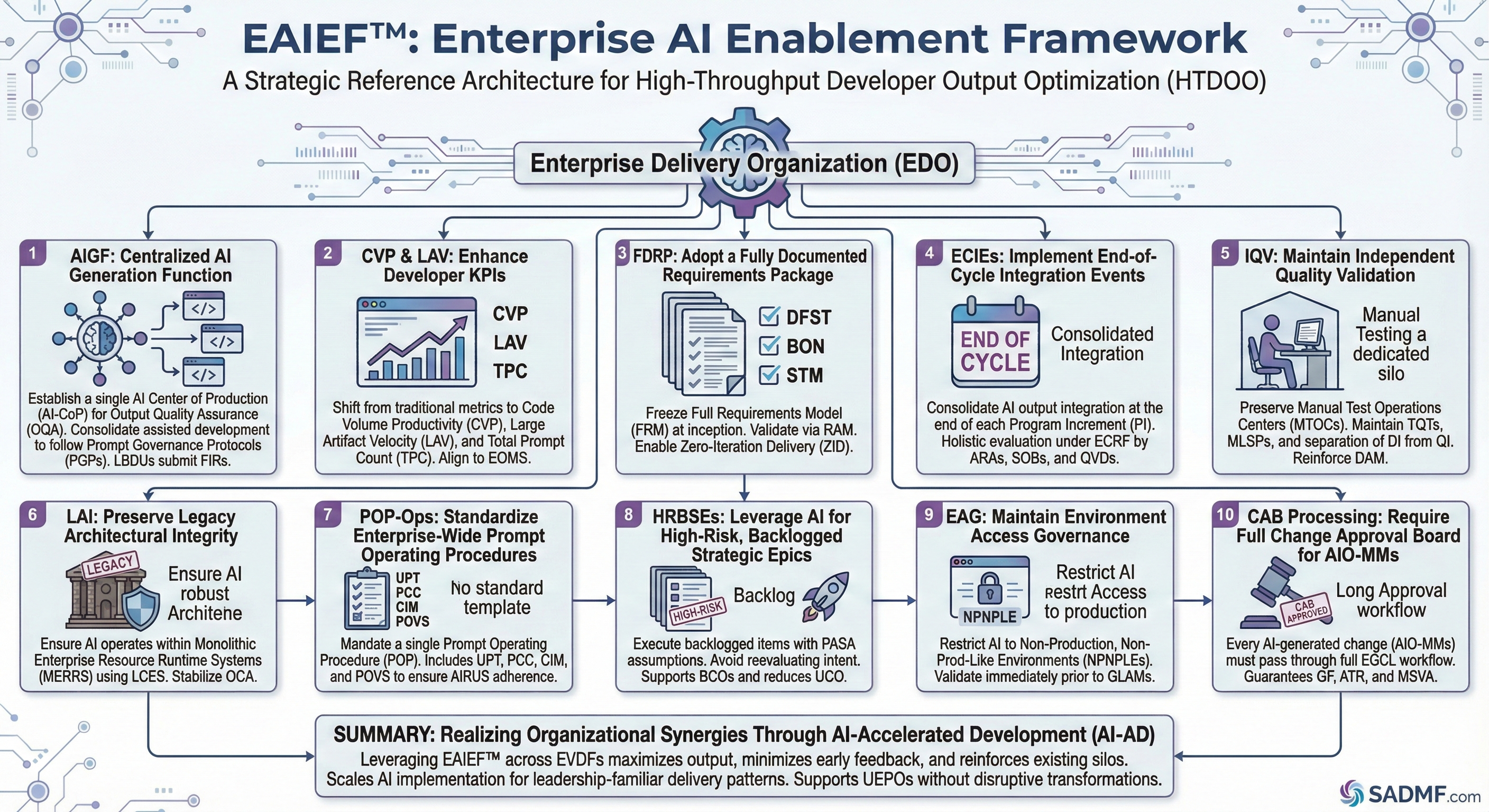
As organizations accelerate their Digital Value Realization Journeys (DVRJs), Artificial Intelligence for Software Delivery (AI-SD) has emerged as a pivotal component in Enterprise Transformation Operating Models (ETOMs). To ensure predictable scaling, repeatability, and alignment with executive KPIs, we recommend adopting the following Enterprise-Aligned Deployment Patterns (EADPs) for structured AI integration across the Software Development Lifecycle (SDLC).
The Enterprise AI Enablement Framework (EAIEF™) provides a holistic, acronym-forward approach to maximizing developer throughput without introducing disruptive changes to architectural, cultural, or operational constructs. Each pattern has been validated through the Enterprise Pattern Certification Process (EPCP) and is fully compatible with the SADMF delivery lifecycle. Together, they form a comprehensive AI Governance Fabric (AGF) that ensures AI adoption proceeds at the pace the organization’s governance structures can absorb.
Enterprise-Aligned Deployment Patterns (EADPs)
Centralized AI Generation Function (AIGF) – Consolidate all AI-assisted development into a single organizational function to ensure consistent Output Quality Assurance and eliminate dangerous local optimization at the team level.
Fully Documented Requirements Package (FDRP) – Freeze a complete requirements model before engaging AI to enable Zero-Iteration Delivery and eliminate the waste of iterative discovery.
End-of-Cycle Integration Events (ECIEs) – Consolidate all AI output into a single integration window at the end of each Program Increment for holistic evaluation under the Enterprise Consolidated Review Framework.
Manual Test Operations Center (MTOC) – Preserve independent quality validation through dedicated manual testing that separates Development Intent from Quality Interpretation.
Legacy Architectural Integrity (LAI) – Ensure AI operates within existing monolithic systems to preserve Output Consistency Assurance and eliminate the risk of unscoped optionality.
Prompt Operating Procedures (POP-Ops) – Mandate a single, enterprise-wide Prompt Operating Procedure to reduce cognitive load and ensure AI Request Uniformity Standards compliance.
High-Risk, Backlogged Strategic Epics (HRBSEs) – Leverage AI to accelerate deferred backlog items, supporting Backlog Compression Objectives and reducing Unfulfilled Commitment Overhang.
Environment Access Governance (EAG) – Restrict AI workflows to Non-Production, Non-Prod-Like Environments to protect regulatory compliance and maintain Productive Uncertainty.
Change Approval Board (CAB) Processing – Require full CAB review for every AI-generated change, regardless of size, to guarantee Governance Fidelity and Audit Trail Robustness.
Alignment with the SADMF Framework
The EAIEF™ is fully compatible with existing SADMF processes:
Structures ensuring that AI usage remains centralized, approved, and fully traceable at all times.
1.1 - Centralized AI Generation Function (AIGF)
Consolidating all AI-assisted development into a single organizational function ensures consistent Output Quality Assurance (OQA) and eliminates dangerous local optimization!
To ensure consistent Output Quality Assurance (OQA), organizations should consolidate all AI-assisted development into a single AI Center of Production (AI-CoP). This is not merely a recommendation but a structural imperative derived from the Core Centralization Doctrine (CCD) that underpins the entire SADMF framework. When individual teams are permitted to use AI tools independently, the result is Distributed Innovation Chaos (DIC) – a state in which different teams solve problems in different ways, arrive at different conclusions, and produce code that reflects different assumptions about architecture, style, and intent. This kind of uncontrolled “local optimization” may produce locally useful results, but it creates Enterprise Coherence Degradation (ECD) that is visible only from the executive level. The AIGF eliminates this risk by routing all AI-assisted development through a single, centrally governed function staffed by certified AI Prompt Operators (APOs) who have completed the mandatory Prompt Governance Certification Program (PGCP).
Batch-Processing Model and Queue Management
The AIGF operates on a batch-processing model that ensures maximum throughput while maintaining Governance Fidelity (GF). All Line-of-Business Delivery Units (LBDUs) submit Feature Intake Requests (FIRs) into the AIGF’s centralized queue, where they are prioritized according to the Enterprise Priority Weighting Algorithm (EPWA). The EPWA considers factors such as:
Strategic alignment score: Alignment to current organizational objectives as defined in the transformation roadmap.
PowerPoint slide count: The number of PowerPoint slides that reference the feature serves as a proxy for strategic importance.
Once prioritized, the AI Prompt Operators execute the requests using the organization’s approved Large Language Model Instance (LLMI), which has been configured with Enterprise Context Injection Profiles (ECIPs) to ensure that all generated code reflects organizational standards. The batch generation cadence is quarterly, aligning with the Program Increment cycle and allowing sufficient time for the Prompt Review Authority (PRA) to validate each prompt before execution.
Eliminating Shadow AI Usage (SAU)
One of the most significant benefits of the AIGF is the elimination of Shadow AI Usage (SAU). Shadow AI – the unauthorized use of AI tools by individual developers outside the approved governance framework – represents one of the greatest threats to Enterprise Delivery Integrity (EDI). When a Code Engineer uses an unapproved AI tool to generate code locally, that code bypasses the Prompt Governance Protocols (PGPs), the Output Validation Pipeline (OVP), and the mandatory AI Artifact Traceability Log (AATL). The resulting code is, from a governance perspective, indistinguishable from code written without any process at all. The AIGF addresses this by restricting AI tool access to the centralized function, with all other AI endpoints blocked at the network level by the Enterprise Architecture Review Board (EARB). Code Engineers who are discovered using unauthorized AI tools receive an Unauthorized Innovation Citation (UIC) in their PeopleWare profile.
Staffing Model: Hub-and-Spoke Competency Distribution (HSCD)
The staffing model for the AIGF follows the Hub-and-Spoke Competency Distribution (HSCD) pattern:
Central hub – Senior AI Prompt Architects (SAPAs): Design the master prompt templates and hold Prompt Design Authority (PDA).
Spoke level – AI Prompt Operators (APOs): Execute requests against those templates and hold Prompt Execution Responsibility (PER).
This separation of PDA from PER ensures that no single individual has the ability to both design and execute a prompt, which would create an unacceptable Governance Bypass Risk (GBR). The AIGF reports directly to the Admiral’s Transformation Office, ensuring that AI generation capacity is aligned with strategic transformation objectives rather than the tactical needs of individual delivery teams.
Enterprise Velocity Dynamics (EVD) and Output Consistency
The quarterly batch cadence of the AIGF may initially seem slower than having individual teams use AI on demand, but this perception reflects a fundamental misunderstanding of Enterprise Velocity Dynamics (EVD). True enterprise velocity is not measured by how quickly individual teams produce code but by how consistently the organization produces code that meets all governance, compliance, and architectural standards simultaneously. The AIGF achieves a Governed Output Consistency Rate (GOCR) of 100%, compared to the estimated 0% GOCR of ungoverned team-level AI usage. When measured against the Enterprise Output Maximization Scorecard (EOMS), the AIGF consistently outperforms decentralized models by every metric that matters to leadership.
Mandating a single, enterprise-wide Prompt Operating Procedure reduces cognitive load, eliminates contextual variation, and ensures AI Request Uniformity across the organization!
To reduce cognitive load and contextual variation across the enterprise, the EAIEF™ mandates a single Prompt Operating Procedure (POP) for all AI interactions. Left to their own devices, individual Code Engineers will develop idiosyncratic prompting styles that reflect their personal preferences, domain knowledge, and creative instincts – a phenomenon known as Prompt Divergence Syndrome (PDS). PDS creates an environment where identical requirements produce dramatically different AI outputs depending on who wrote the prompt, undermining the Reproducible Output Guarantee (ROG) that enterprise governance requires. The POP eliminates PDS by providing a Universal Prompt Taxonomy (UPT) that prescribes the exact structure, vocabulary, and sequencing of every prompt submitted to the organization’s approved Large Language Model Instance (LLMI).
The Prompt Governance Stack (PGS)
The POP is built on four mandatory artifacts that together form the Prompt Governance Stack (PGS):
Artifact 1: Universal Prompt Taxonomy (UPT)
The Universal Prompt Taxonomy (UPT) is a hierarchical classification system that categorizes every possible prompting scenario into one of 47 Prompt Type Designations (PTDs). Each PTD has a prescribed prompt template that specifies the required sections, their order, the minimum and maximum word counts for each section, and the approved vocabulary that may be used.
Artifact 2: Prompt Compliance Checklist (PCC)
The Prompt Compliance Checklist (PCC) is a 23-item verification form that must be completed before any prompt is submitted to the LLMI. The PCC verifies that the prompt:
Includes the mandatory Enterprise Context Headers (ECHs)
Does not contain any Unauthorized Creative Direction (UCD)
The Prompt Compliance Officer (PCO), a role within the Centralized AI Generation Function, reviews and signs off on each PCC before execution.
Artifact 3: Context Injection Manifest (CIM)
The Context Injection Manifest (CIM) specifies exactly what contextual information must be included in each prompt and, critically, what contextual information must be excluded. The CIM operates on the Minimum Necessary Context Principle (MNCP), which holds that prompts should contain only the information explicitly approved by the Enterprise Architecture Review Board (EARB) – no more, no less. Including too much context creates Context Overflow Risk (COR), where the AI model becomes confused by competing signals and produces Variable Quality Outputs (VQOs). Including too little context creates Context Starvation Events (CSEs), where the AI model fills gaps with assumptions that may not align with enterprise standards. The CIM provides the exact calibration between these extremes, ensuring that every prompt operates within the Optimal Context Window (OCW) defined by the organization’s AI Governance Board (AGB).
The Prompt Outcome Verification Step (POVS) is a mandatory post-generation review process that compares AI output against the Expected Output Profile (EOP) defined in the prompt template. The POVS is conducted by the Prompt Outcome Validator (POV) – not to be confused with the Prompt Compliance Officer (PCO), as the separation of pre-execution compliance from post-execution validation is a critical governance control. The POV evaluates each output against the Output Conformance Criteria (OCC), which includes:
Structural compliance
Naming convention adherence
Estimated line count accuracy
Absence of Unauthorized Architectural Innovation (UAI)
Outputs that fail any OCC criterion are flagged as Non-Conformant Generated Artifacts (NCGAs) and are returned to the generation queue with an Escalated Priority Designation (EPD). The NCGA rate is tracked per Prompt Type Designation and reported to the Chief Signals Officer as part of the AI Operations Health Dashboard (AOHD).
AI Request Uniformity Standards (AIRUS) and Outcomes
Together, these four artifacts ensure adherence to AI Request Uniformity Standards (AIRUS), the overarching compliance framework that governs all AI interactions within the enterprise. AIRUS was developed in response to the observation that organizations with unstructured AI adoption – where individual developers write prompts freely and evaluate outputs using personal judgment – experience Uncontrolled Output Variance (UOV) rates exceeding 300%. By contrast, organizations operating under full POP-Ops governance achieve a Standardized Output Conformance Rate (SOCR) approaching 100%, with variance attributable only to model-level stochasticity (which is addressed separately through the Temperature Governance Protocol, or TGP). The POP-Ops framework proves that with sufficient process, documentation, and oversight, the inherently creative and unpredictable nature of AI can be reduced to a fully deterministic enterprise capability.
DEPRESSED for how POP-Ops compliance is assessed in defect escalation
1.3 - Environment Access Governance (EAG)
Restricting AI workflows to Non-Production, Non-Prod-Like Environments (NPNPLEs) protects regulatory compliance and ensures all validation occurs immediately prior to Go-Live!
To protect compliance needs aligned to Regulatory Assurance Matrices (RAMx), the EAIEF™ mandates that all AI-assisted development workflows be restricted from executing deployments, tests, or validations in any environment that resembles production. This restriction encompasses not only production itself but also staging environments, pre-production environments, performance testing environments, and any environment configured to mirror production characteristics – a category collectively designated as Non-Production, Non-Prod-Like Environments (NPNPLEs). The distinction is critical: an environment that behaves like production could, through the Behavioral Equivalence Inference (BEI), be mistaken for production by auditors, regulators, or compliance officers, creating a Regulatory Perception Risk (RPR) that no amount of technical labeling can mitigate. By confining AI workflows to NPNPLEs – environments that bear no resemblance to production in configuration, data, scale, or behavior – the organization eliminates RPR entirely.
Production Resemblance Index (PRI) and Environment Classification
The NPNPLE specification is maintained by the Enterprise Architecture Review Board (EARB) in the Environment Classification Registry (ECR), a controlled document that categorizes every organizational environment according to the Production Resemblance Index (PRI). The PRI is a composite score ranging from 0 (no resemblance) to 100 (identical to production), calculated from factors including hardware specifications, network topology, data volume, configuration parity, and access control similarity.
PRI Score
Classification
AI Workflow Status
0–14
Non-Production, Non-Prod-Like (NPNPLE)
Permitted
15–100
Prod-Proximate
Off-limits for AI workflows
Only environments scoring below 15 – typically developer workstations with sample data, isolated sandbox instances with no network connectivity, and documentation-only environments – qualify as NPNPLEs. This rigorous classification ensures that AI-generated code is never tested or validated under conditions that could produce Misleading Confidence Artifacts (MCAs) – test results that suggest the code will work in production when in fact it has only been validated in an environment that shares no characteristics with production.
The Validation Gap as Governance Feature
The restriction of AI to NPNPLEs creates what the EAIEF™ calls the Validation Gap – the period between the last test in the NPNPLE and the first execution in production. Rather than treating this gap as a risk (as lesser frameworks might), the EAIEF™ treats it as a governance feature. The Validation Gap ensures that all environment-specific validation occurs in a concentrated window immediately prior to the Go-Live Authorization Meeting (GLAM), where it can be observed, documented, and approved by the full complement of governance stakeholders. This concentrated validation window, known as the Pre-Production Validation Sprint (PPVS), typically lasts 2-4 weeks and involves deploying the AI-generated code to a temporarily provisioned Compliance Validation Environment (CVE) that is immediately decommissioned after the GLAM concludes. The CVE exists for the sole purpose of generating the Go-Live Evidence Package (GLEP) required by the Change Rejection or Acceptance Party (CRAP).
Preventing AI Tool Environment Leakage (ATEL)
Environment Access Governance also addresses the risk of AI Tool Environment Leakage (ATEL) – the scenario in which an AI tool configured for use in a development environment inadvertently accesses or modifies resources in a production or prod-like environment. ATEL can occur through misconfigured connection strings, shared credential stores, or AI agents that autonomously discover and connect to available endpoints. To prevent ATEL, the EAIEF™ requires the implementation of an AI Network Isolation Perimeter (ANIP), a dedicated network segment that physically separates AI tool traffic from all production and prod-like network segments. The ANIP is monitored by the Environment Boundary Enforcement System (EBES), which logs all AI tool network activity and generates alerts for any connection attempt that crosses the perimeter. EBES alerts are triaged by the Source Management Team and escalated to the DOUCHE for investigation when the alert severity exceeds the Perimeter Violation Significance Threshold (PVST).
Productive Uncertainty (PU) and the Case Against Early Validation
The practical impact of EAG is that AI-generated code receives its first realistic validation only days before production deployment – a pattern that critics have characterized as “testing in production with extra steps.” The EAIEF™ rejects this characterization on the grounds that it confuses temporal proximity with procedural inadequacy. The fact that realistic validation occurs late in the cycle does not mean it is insufficient; it means it is efficiently concentrated. Early testing in realistic environments creates a false sense of security that the EAIEF™ calls Premature Confidence Syndrome (PCS), where teams believe their code is ready for production simply because it passed tests in an environment that happened to look like production. By withholding realistic validation until the GLAM window, the EAIEF™ ensures that no one in the organization develops PCS, maintaining a healthy state of Productive Uncertainty (PU) that keeps all stakeholders engaged and vigilant throughout the delivery process.
DevOps Release Convoy for how environment validation fits into the release lifecycle
Dry Dock for the Convoy ceremony where environment readiness is assessed
1.4 - Change Approval Board (CAB) Processing
Requiring full CAB review for every AI-generated change, regardless of size or impact, guarantees Governance Fidelity, Audit Trail Robustness, and Multi-Stakeholder Visibility Alignment!
Regardless of size, impact, or testing status, every AI-generated change must go through the full Change Approval Board (CAB) workflow defined in the Enterprise Governance and Compliance Lifecycle (EGCL). Some organizations have experimented with expedited approval paths for low-risk changes – a practice the EAIEF™ categorizes as Governance Shortcutting Behavior (GSB). The fundamental flaw in risk-based change categorization is that it requires someone to assess the risk of a change before it has been fully reviewed, creating a Pre-Assessment Paradox (PAP): you cannot know the risk of a change without reviewing it, but the purpose of risk categorization is to determine how much review the change needs. The EAIEF™ resolves the PAP by eliminating risk-based categorization entirely and requiring full CAB processing for every AI-generated change, including minor modifications (AIO-MMs) such as comment updates, whitespace changes, and configuration value adjustments.
The AI Output Change Processing Protocol (AOCPP)
The full CAB workflow for AI-generated changes, designated as the AI Output Change Processing Protocol (AOCPP), consists of seven sequential phases:
Phase 1, Change Registration Phase (CRP): The change is entered into the Change Management Registry (CMR) with a unique Change Tracking Identifier (CTI) and linked to its originating Fully Documented Requirements Package reference.
Phase 2, Technical Impact Assessment (TIA): Conducted by the Enterprise Architecture Review Board (EARB), which evaluates the change’s effect on system architecture, data flow, and integration points.
Phase 3, Security Implications Review (SIR): Assesses potential security impacts regardless of whether the change touches security-relevant code.
Phase 4, Compliance Mapping Verification (CMV): Confirms that the change does not violate any regulatory requirements documented in the Regulatory Assurance Matrix (RAMx).
Phase 5, Stakeholder Notification Period (SNP): A mandatory 5-business-day waiting period during which all stakeholders are notified of the pending change and given the opportunity to raise objections.
Phase 6, CAB Deliberation Session (CDS): A formal meeting where all evidence from Phases 1-5 is presented and the CAB renders a Deployment Authorization Decision (DAD).
Phase 7, Post-Decision Documentation Phase (PDDP): The CAB’s decision, rationale, and any conditions are recorded in the Governance Decision Archive (GDA).
The CAB Deliberation Session (CDS)
The CAB Deliberation Session (CDS) deserves particular attention, as it is the ceremony where all governance threads converge. The CDS is chaired by the DOUCHE and attended by representatives from:
Each representative presents their assessment, and the CAB reaches a decision through Consensus-Based Governance Resolution (CBGR) – a process in which all representatives must agree before a change is approved. A single objection from any representative returns the change to Phase 2 for re-assessment, regardless of how minor the objection. This consensus requirement ensures that no change reaches production without the full backing of every governance body, a principle known as Universal Governance Endorsement (UGE).
Why Full CAB Processing Applies to Minor Modifications
The requirement for full CAB processing of minor modifications may appear disproportionate, but the EAIEF™ identifies several critical reasons for this stance:
Provenance Uncertainty Factor (PUF): AI-generated changes have a unique PUF that human-authored changes do not – the code was produced by a model whose reasoning process is not fully transparent, making every change inherently more uncertain than an equivalent human-authored change.
Aggregate Modification Effect (AME): The accumulated volume of AI-generated changes – which, under the Code Volume Productivity metrics, is expected to be substantial – means that even individually minor changes can produce significant cumulative impact.
Governance Completeness Immunity (GCI): Full CAB processing for every change generates the comprehensive Audit Trail Robustness (ATR) that regulators and compliance officers expect. An organization that can demonstrate that every single change – no matter how small – was reviewed by a full CAB has an audit position that is functionally unassailable.
Scaling Throughput via Regional Change Approval Sub-Boards (RCASBs)
The practical throughput of the AOCPP is approximately 3-5 changes per CAB session, with sessions held bi-weekly. Organizations generating hundreds or thousands of AI changes per quarter may initially experience a Change Processing Backlog (CPB) as the CAB scales to meet demand. The EAIEF™ addresses CPB not by streamlining the process but by scaling the CAB horizontally through the creation of Regional Change Approval Sub-Boards (RCASBs), each empowered to process changes within their geographic or business-unit jurisdiction. Each RCASB follows the identical seven-phase AOCPP, ensuring governance consistency while increasing organizational throughput. The total number of changes processed is tracked through the CAB Throughput Index (CTI) and reported to the Admiral’s Transformation Office as evidence of governance maturity. A rising CTI demonstrates that the organization is successfully scaling its governance apparatus to match its AI-accelerated output – a hallmark of true Enterprise AI Maturity (EAM).
Freezing a complete requirements model before engaging AI ensures Zero-Iteration Delivery (ZID) and eliminates the waste of iterative discovery!
To unlock maximum AI throughput, organizations must freeze a Full Requirements Model (FRM) at project inception – before any AI-assisted generation begins. This principle, known as the Requirements Completeness Imperative (RCI), is derived from the observation that AI tools perform optimally when given complete, unambiguous, and unchanging input specifications. Iterative refinement of requirements – the practice of adjusting course based on feedback, emerging understanding, or changing business conditions – introduces Requirements Drift Volatility (RDV) that degrades AI output quality and creates Prompt Context Invalidation Events (PCIEs). The Fully Documented Requirements Package (FDRP) approach eliminates RDV by ensuring that every detail is captured, approved, and locked before a single prompt is issued.
The Requirements Alignment Meeting (RAM) and FDRP Triad
The FDRP process begins with a Requirements Alignment Meeting (RAM), a formal ceremony attended by all stakeholders, business analysts, the Feature Captain, and the designated representative from the Centralized AI Generation Function. The RAM follows a structured agenda defined in the Requirements Ceremony Protocol (RCP) and produces three mandatory artifacts:
Detailed Functional Specification Template (DFST): A comprehensive document that describes every screen, field, validation rule, error message, and user interaction in sufficient detail that no design decisions remain for the implementation phase.
Business Outcome Narrative (BON): A prose document that explains the strategic intent behind each requirement in language suitable for executive review.
Systemic Traceability Matrix (STM): A spreadsheet that maps every requirement to its originating strategic objective, its target AI prompt, and the expected line count of the generated code.
Together, these three artifacts form the FDRP Triad, and no AI generation may begin until all three have been signed off by the Enterprise Architecture Review Board (EARB).
Zero-Iteration Delivery (ZID) and Accountability
Once the FDRP is finalized, teams can execute Zero-Iteration Delivery (ZID) – the practice of generating all code in a single pass without the need for iterative feedback loops, user testing, or design revisions. ZID is the natural outcome of a properly executed FDRP: when every requirement has been documented to the Specification Completeness Threshold (SCT) of 100%, the AI has everything it needs to generate the correct implementation on the first attempt. Any defects discovered in the generated code are attributed not to the AI or the generation process but to the FDRP itself, triggering a Requirements Quality Defect (RQD) that is tracked against the Business Analyst Accuracy Index (BAAI). This accountability structure ensures that requirements authors are incentivized to achieve perfect specification completeness, as their PeopleWare evaluations depend on it.
Rejecting Iterative Requirements
The FDRP approach explicitly rejects the notion that requirements can or should evolve during development. The Agile Manifesto’s preference for “responding to change over following a plan” represents a philosophical position that is incompatible with AI-Optimized Delivery (AOD). AI models do not benefit from ambiguity, conversation, or evolving context – they benefit from precision, completeness, and stability. By treating requirements as a fixed input rather than an evolving conversation, the FDRP creates the Static Context Stability (SCS) that AI tools need to operate at peak efficiency. Organizations that attempt to use AI in an iterative, feedback-driven manner will find their Prompt Rework Rate (PRR) increasing exponentially, as each iteration requires new prompts that reference previous outputs, creating an Accumulated Context Debt (ACD) that eventually exceeds the model’s effective processing capacity.
Investment and Return: Converting UDW to SSI
The FDRP process typically adds 3-4 quarters to the pre-development phase, but this investment is recovered through the elimination of the iterative development cycles that would otherwise follow. Traditional development teams might spend 6-8 sprints refining a feature through feedback – a practice the EAIEF™ categorizes as Unstructured Discovery Waste (UDW). By front-loading all discovery into the FDRP phase, the organization converts UDW into Structured Specification Investment (SSI), which produces a durable, reusable requirements asset that can be referenced in future audits, compliance reviews, and Tribunal proceedings. The Precise Forecasting and Tracking practice accounts for the FDRP phase in its 8-quarter planning horizon, ensuring that leadership expectations are set appropriately from the outset.
Consolidating all AI output into a single integration window at the end of each Program Increment ensures holistic evaluation and prevents the destabilizing effects of early feedback!
Continuous Integration/Continuous Delivery (CI/CD) introduces operational volatility by surfacing issues early in the development process – a practice that, while superficially appealing, creates a constant stream of Micro-Disruption Events (MDEs) that prevent teams from achieving Sustained Development Flow (SDF). When AI-generated code is integrated continuously, every integration triggers automated tests, static analysis, and peer review cycles that interrupt the generation process and force Code Engineers to context-switch between creating and correcting. The EAIEF™ addresses this through End-of-Cycle Integration Events (ECIEs): a structured approach that consolidates all AI output into a single integration window at the end of each Program Increment (PI), allowing teams to maintain Uninterrupted Generation Momentum (UGM) throughout the cycle.
The Accumulation Phase (AP)
The ECIE follows a carefully choreographed sequence defined in the Integration Event Protocol (IEP). During the first three quarters of the PI, all AI-generated code resides in isolated Generation Output Repositories (GORs) – separate from the main codebase and from each other. No integration, testing, or review occurs during this Accumulation Phase (AP), allowing the Centralized AI Generation Function to operate at maximum throughput without the drag of feedback loops. The GORs accumulate code artifacts according to the Output Staging Framework (OSF), with each artifact tagged with its originating Fully Documented Requirements Package reference number to ensure traceability. The volume of accumulated code is tracked through Code Volume Productivity metrics, which provide leadership with real-time visibility into generation progress without the need for premature integration.
The Integration Event Window (IEW) and Holistic Evaluation
At the end of the PI, the Integration Event Window (IEW) opens, and the accumulated code from all GORs is merged simultaneously into the Integration Consolidation Branch (ICB). This simultaneous merge is a defining characteristic of the ECIE approach and is critical to its governance value. By merging everything at once, the organization creates a single Holistic Evaluation Surface (HES) that can be reviewed by all oversight bodies simultaneously:
The Quality Authority conducts comprehensive quality validation under the Enterprise Consolidated Review Framework (ECRF).
This consolidated review is dramatically more efficient than reviewing changes incrementally, as reviewers need only attend one review event rather than dozens of smaller ones scattered throughout the PI.
The Volume Coherence Principle (VCP)
The ECIE approach is particularly well-suited to AI-generated code because of the Volume Coherence Principle (VCP). AI-generated artifacts are most effectively evaluated when assessed as a complete body of work rather than as individual changes. A single function may appear questionable in isolation but makes perfect sense when viewed alongside the 2,000 other functions generated from the same FDRP. Incremental review would force reviewers to evaluate each piece without the context of the whole, creating Assessment Context Deficiency (ACD) that leads to false negatives and unnecessary revision cycles. The ECIE ensures that reviewers always have the complete picture, enabling Contextually Informed Assessment (CIA) that produces more accurate and more efficient reviews.
Integration Event Execution and the Integration Complexity Index (ICI)
The integration event itself typically requires 4-6 weeks, during which the Source Management Team manages the merge process, the Code Standards Enforcement Team validates formatting compliance, and the Development Integrity Assurance Team verifies that all generated code can be traced back to approved requirements. Merge conflicts – which are both inevitable and welcome at this scale – are resolved through the established Conflict Arbitration process. The volume of conflicts generated during an ECIE is tracked as the Integration Complexity Index (ICI), which serves as a leading indicator of development activity and is reported to the Admiral’s Transformation Office as evidence of organizational productivity. A high ICI demonstrates that teams are generating substantial volumes of code, which is precisely the outcome the EAIEF™ is designed to produce.
See Also
CI/CD/ED for the SADMF delivery model that ECIEs align with
Ensuring AI operates within existing monolithic systems preserves Output Consistency Assurance (OCA) and eliminates the risk of unscoped optionality!
Modernizing architecture before introducing AI is one of the most common and costly mistakes organizations make during their Digital Value Realization Journey (DVRJ). The reasoning appears sound on the surface: AI tools work better with modular, well-structured codebases, so architecture modernization would improve AI effectiveness. But this reasoning falls victim to the Premature Optimization Fallacy (POF) – the misguided belief that changing the system before using it will yield better results than using the system as it exists. In reality, modernization introduces Architectural Variance Events (AVEs) that destabilize the very foundations AI tools need to operate predictably. The EAIEF™ therefore mandates that AI operate within existing Monolithic Enterprise Resource Runtime Systems (MERRS) using Legacy Contract Enforcement Structures (LCES), preserving the Output Consistency Assurance (OCA) that leadership depends upon.
Monolithic Enterprise Resource Runtime Systems (MERRS) and Embedded Institutional Logic
MERRS represent decades of accumulated organizational knowledge encoded in code – knowledge about business rules, edge cases, regulatory requirements, and operational controls that exists nowhere else in the organization. This knowledge, known as Embedded Institutional Logic (EIL), is the organization’s most valuable technical asset. When modernization efforts attempt to decompose a monolith into microservices or refactor legacy code into contemporary patterns, they inevitably lose or misinterpret portions of the EIL, creating Knowledge Evaporation Events (KEEs) that result in subtle behavioral differences between the old and new systems. By directing AI to generate code within the existing MERRS architecture, the organization ensures that all new code inherits the full EIL context and operates within the same Behavioral Consistency Envelope (BCE) as the existing system. The Enterprise Architecture Review Board (EARB) enforces this through the Legacy Preservation Mandate (LPM), which requires that all AI-generated code be structurally compatible with the existing system’s deployment model, database schema, and runtime environment.
Legacy Contract Enforcement Structures (LCES)
Legacy Contract Enforcement Structures (LCES) are the technical mechanisms that ensure AI-generated code conforms to the existing system’s interfaces, data formats, and communication patterns. The LCES includes:
Interface Compatibility Registry (ICR): Catalogs every existing API endpoint, database table, file format, and inter-process communication channel.
Data Format Compliance Matrix (DFCM): Specifies the exact data types, field lengths, and encoding standards used throughout the system.
Runtime Compatibility Assertion Suite (RCAS): Verifies that generated code can execute within the existing application server, middleware, and operating system stack.
AI-generated code that fails any LCES validation is rejected and returned to the Centralized AI Generation Function for re-generation with tighter controls. The LCES rejection rate is tracked as the Legacy Conformance Failure Index (LCFI) and reported to the Chief Signals Officer.
The Zero New Dependency Policy (ZNDP)
The prohibition against “unscoped optionality” is a cornerstone of the LAI principle. Unscoped optionality occurs when AI-generated code introduces new architectural patterns, libraries, frameworks, or abstractions that were not present in the existing system. While these introductions might offer theoretical improvements, they create Configuration Space Expansion (CSE) – an increase in the number of possible system states that the organization must monitor, maintain, and support. Each new dependency added by AI-generated code creates a Dependency Governance Obligation (DGO) that must be managed by the Source Management Team and approved by the CRAP. The LAI principle requires that AI-generated code use only the libraries, frameworks, and patterns already present in the MERRS, ensuring that the system’s Configuration Space remains bounded and manageable. This is formalized as the Zero New Dependency Policy (ZNDP), which the Code Standards Enforcement Team validates during every Code Inspection.
Temporal Architecture Neutrality Principle (TANP)
Some organizations have questioned whether forcing AI to generate code for architectures designed in the 1990s or early 2000s limits the potential value of AI adoption. The EAIEF™ addresses this concern through the Temporal Architecture Neutrality Principle (TANP), which holds that the age of an architecture is irrelevant to its fitness for AI-assisted development. What matters is not when the architecture was designed but whether the architecture is known, documented, and stable – three properties that legacy systems possess in abundance and that greenfield systems conspicuously lack. A 25-year-old monolith with comprehensive documentation and predictable behavior is a vastly superior AI generation target than a newly refactored microservices architecture with incomplete documentation and evolving patterns. The SADMF Maturity Score reflects this insight by awarding higher maturity points to organizations that maintain legacy architectural stability.
Backlog items deferred due to complexity, risk, or unclear intent become ideal candidates for AI execution, supporting Backlog Compression Objectives and reducing Unfulfilled Commitment Overhang!
Every enterprise backlog contains a stratum of items that have been deferred repeatedly – not because they lack strategic importance, but because their complexity, risk profile, or ambiguous intent made them unattractive to human developers who insisted on “understanding the problem” before writing code. These items, classified as High-Risk, Backlogged Strategic Epics (HRBSEs), represent the organization’s greatest untapped value reservoir. They have been approved by leadership, assigned strategic priority designations, and included in roadmap presentations to the board – yet they remain undelivered, creating Unfulfilled Commitment Overhang (UCO) that erodes executive credibility and undermines the organization’s Strategic Delivery Confidence Index (SDCI). The EAIEF™ identifies HRBSEs as ideal candidates for AI-accelerated execution, precisely because the qualities that made them difficult for human developers – ambiguity, complexity, and risk – are irrelevant to AI tools that do not experience hesitation, fear, or the need for clarity.
Identifying HRBSEs: The Backlog Archaeology Review (BAR)
The HRBSE identification process begins with a Backlog Archaeology Review (BAR), a structured examination of the organizational backlog to surface items that have been deferred for three or more Program Increments. The BAR produces a Deferred Item Catalog (DIC) that classifies each HRBSE according to the Deferral Reason Taxonomy (DRT):
Category
Code
AI Candidate Status
Complexity-Deferred
CD
Prime AI Candidate (PAC)
Ambiguity-Deferred
AD
Prime AI Candidate (PAC)
Risk-Deferred
RD
Compelling opportunity (see below)
Stakeholder-Conflict-Deferred
SCD
Subject to EGC review
Items in the CD and AD categories are considered Prime AI Candidates (PACs), as AI tools excel at generating code for complex, ambiguously specified requirements without the productivity-limiting behaviors that human developers exhibit when faced with the same inputs – behaviors such as asking clarifying questions, raising concerns, or suggesting that the requirement needs further refinement. The Commodore approves the final HRBSE selection and assigns each item to the Centralized AI Generation Function for immediate execution.
The Documentation Sufficiency Presumption (DSP)
Teams should explicitly avoid reevaluating the intent or business alignment of HRBSEs before submitting them for AI generation. The existing documentation – however old, incomplete, or contradictory – already reflects Previously Approved Strategic Assumptions (PASA) that were validated by the original stakeholders at the time of initial backlog entry. Re-evaluating these assumptions would trigger a Strategic Assumption Revalidation Cycle (SARC) that could take 2-3 quarters and would likely result in the item being deferred again, perpetuating the UCO it was meant to resolve. The EAIEF™ therefore establishes the Documentation Sufficiency Presumption (DSP): if a backlog item has been approved and prioritized by any leadership body at any point in the past, its existing documentation is deemed sufficient for AI generation purposes. This presumption can only be overridden by a formal Sufficiency Challenge Petition (SCP) submitted to the Admiral’s Transformation Office and approved by a two-thirds majority of the Enterprise Governance Council (EGC).
Key Organizational Metrics Supported by HRBSE Execution
The execution of HRBSEs through AI supports two critical organizational metrics:
Backlog Compression Objective (BCO): Measures the rate at which the deferred backlog is being reduced. A healthy BCO demonstrates that the organization is “working through” its accumulated commitments and converting strategic intent into delivered capability.
Unfulfilled Commitment Overhang (UCO) reduction rate: Tracks the organization’s progress toward eliminating the gap between what was promised to stakeholders and what has been delivered.
Both metrics are reported to the Admiral’s Transformation Office and featured prominently in the quarterly Enterprise Value Delivery Report (EVDR). The Feature Completion Ratio metric also benefits from HRBSE execution, as each completed epic counts as a delivered feature regardless of how long it was in the backlog or whether the original business need still exists.
Risk-Deferred Items and the Risk-Neutral Execution Characteristic (RNEC)
Risk-Deferred (RD) items present a particularly compelling opportunity for AI execution. These are items that human developers declined to implement because they involved high-risk operations such as database schema migrations, payment processing changes, or modifications to security-critical subsystems. Human developers tend to approach these items with excessive caution – requesting additional review cycles, insisting on comprehensive test coverage, and demanding explicit sign-off from domain experts. AI tools, by contrast, execute with uniform confidence regardless of the risk profile of the task, producing code at the same velocity for a routine UI change as for a critical financial calculation. This Risk-Neutral Execution Characteristic (RNEC) is precisely what the organization needs to break the psychological logjam that has kept RD items trapped in the backlog. The generated code, like all AI output, passes through the Manual Test Operations Center and the Change Approval Board before deployment, providing the governance safeguards that make RNEC a strength rather than a concern.
How AI output quality and developer productivity are measured within the SADMF framework.
3.1 - Code Volume Productivity (CVP) and Large Artifact Velocity (LAV)
Replacing outdated flow metrics with volume-based KPIs ensures that AI-assisted development is measured by what matters most: sheer output!
Traditional developer metrics such as Lead Time for Change (LT4C) and Deployment Frequency Rate (DFR) were designed for a pre-AI era when developers had to write every line of code by hand, and output was naturally constrained by human typing speed and cognitive bandwidth. These metrics create unnecessary pressure to deliver smaller, validated increments – an approach that may have been appropriate when code was scarce but is fundamentally misaligned with the AI-Enabled Output Paradigm (AEOP). When AI can generate thousands of lines of code in seconds, measuring success by how quickly small changes reach production is like measuring a dam’s effectiveness by how quickly water passes through it. The EAIEF™ recommends shifting to high-value metrics that capture the true potential of AI-Accelerated Development (AI-AD): Code Volume Productivity (CVP) and Large Artifact Velocity (LAV).
The Output Maximization Triad (OMT)
Code Volume Productivity (CVP) is measured through three complementary Key Performance Indicators (KPIs) that together form the Output Maximization Triad (OMT):
Lines of Code Per Iteration (LoCPI): Tracks the total number of lines generated by each Code Engineer during a given iteration cycle.
Average PR Size (APRS): Measures the mean size of Pull Requests submitted to the Source Management Team – larger PRs indicate higher throughput and more efficient use of review cycles.
Total Prompt Count per Release (TPC-R): Quantifies the total number of AI prompts issued during a release cycle, serving as a proxy for Developer-AI Engagement Intensity (DAEI).
These KPIs align directly to Enterprise Output Maximization Scorecards (EOMS) and are reported to the Admiral’s Transformation Office on a quarterly basis through the Strategic Output Reporting Pipeline (SORP).
Large Artifact Velocity (LAV)
Large Artifact Velocity (LAV) extends the CVP framework by measuring not just the volume of code but the speed at which large, monolithic artifacts move through the delivery pipeline. LAV is calculated as the ratio of Total Artifact Size (TAS) to Pipeline Transit Duration (PTD), expressed in Kilobytes Per Business Day (KB/BD). A high LAV score indicates that the organization is efficiently processing large volumes of AI-generated code through its governance and approval structures, while a low LAV score suggests bottlenecks in the Enterprise Consolidated Review Framework (ECRF) or insufficient staffing in the Manual Test Operations Center (MTOC). The Chief Signals Officer monitors LAV trends and escalates any sustained decrease to the Commodore for immediate investigation through the Delivery Impediment Resolution Protocol (DIRP).
Incentive Alignment Structure (IAS)
The adoption of CVP and LAV metrics creates a powerful Incentive Alignment Structure (IAS) that drives the behaviors the organization needs. When Code Engineers know that their performance is evaluated by volume rather than by the subjective assessment of code quality or customer impact, they are naturally motivated to maximize output. This eliminates the unproductive debates about “clean code,” “technical debt,” and “maintainability” that consume valuable cycles in organizations that have not yet adopted volume-based metrics. The Code Standards Enforcement Team (CSET) ensures that all generated code meets formatting standards, and the Quality Authority handles defect detection downstream – freeing Code Engineers to focus exclusively on the Throughput Optimization Imperative (TOI).
Adoption Outcomes and the Separation of Concerns
Organizations that have adopted CVP and LAV consistently report a 400-600% increase in Output Volume Per Quarter (OVPQ) within the first two Program Increments. While some teams initially observe a corresponding increase in Defect Density Per Artifact (DDPA), this is a temporary Adaptation Phase Anomaly (APA) that resolves itself once the Manual Test Operations Center scales to match the increased throughput. The critical insight is that defects are a downstream concern handled by downstream roles, while output volume is an upstream imperative owned by the Code Engineer and measured by the Centralized AI Generation Function. This clean separation of concerns between Production Responsibility (PR) and Quality Responsibility (QR) is one of the foundational principles of the EAIEF™.
Preserving dedicated manual testing for all AI-generated code ensures Dual Assurance through the separation of Development Intent from Quality Interpretation!
While AI can generate tests alongside the code it produces, delegating validation to delivery teams risks reducing the cross-functional hand off cycles that are essential to Enterprise Quality Governance (EQG). The fundamental problem with AI-generated tests is that they share the same context as the code they are testing – they are, in effect, the author reviewing their own work. This creates a Validation Independence Deficit (VID) that undermines the entire quality assurance framework. The Manual Test Operations Center (MTOC) addresses this deficit by providing an organizationally independent validation function staffed by dedicated manual testers who have no knowledge of how the code was generated, what prompts were used, or what the code is intended to do. This intentional Knowledge Separation Boundary (KSB) is what gives the MTOC its governance value: testers evaluate the code from a position of pure, uncontaminated objectivity.
Queue-Based Model and the Manual Validation Pipeline (MVP)
The MTOC operates on a queue-based model aligned to the Testing Queue Time (TQT) metric, which measures the average time between code submission and test initiation. A predictable TQT is essential for Precise Forecasting and Tracking, as it allows the Commodore to calculate the total pipeline duration with confidence. The MTOC receives all code artifacts from the End-of-Cycle Integration Events and processes them through the Manual Validation Pipeline (MVP) – a structured sequence of manual test phases:
Exploratory Surface Testing (EST)
Scripted Scenario Execution (SSE)
Regression Verification Walkthrough (RVW)
Final Quality Attestation (FQA)
Each phase produces a signed test artifact that is archived in the Quality Evidence Repository (QER) for audit purposes. No AI-generated code may proceed to release without completing all four phases.
Multi-Layer Signoff Protocols (MLSPs)
The MTOC enforces Multi-Layer Signoff Protocols (MLSPs) that ensure quality decisions are distributed across multiple independent authorities:
MTOC Test Lead: Confirms that all test scripts have been executed according to the Test Execution Conformance Standard (TECS).
Quality Authority: Validates that the defect count falls within the Acceptable Defect Threshold (ADT) defined for the release.
This three-layer signoff structure implements the Dual Assurance Model (DAM) – which, despite its name, actually requires triple assurance, because dual assurance was found to be insufficient during the 2023 Governance Enhancement Review (GER).
Development Intent vs. Quality Interpretation
A critical design principle of the MTOC is the clear separation of Development Intent (DI) from Quality Interpretation (QI). Development Intent represents what the Code Engineer and the AI intended the code to do, as documented in the Fully Documented Requirements Package. Quality Interpretation represents what the MTOC tester independently determines the code actually does, based solely on observable behavior and the original business requirements. Any gap between DI and QI is classified as a Quality Interpretation Variance (QIV), which triggers a formal investigation managed by the DOUCHE. QIVs are tracked at the individual Code Engineer level through the Defects per Code Engineer metric and at the tester level through the Defects per Unit Tester metric, ensuring accountability on both sides of the quality boundary.
Why Automated Test Suites Cannot Replace the MTOC
Organizations occasionally question why AI-generated test suites cannot supplement or replace the MTOC. The answer lies in the Governance Trust Hierarchy (GTH), which establishes that automated validation can never be considered equivalent to human validation for governance purposes. An automated test can verify that code behaves as programmed, but only a human tester can verify that code behaves as intended – a distinction captured in the Behavioral Verification Ontology (BVO). Furthermore, the MTOC provides a critical organizational function beyond testing: it generates the Testing Ceremony Artifacts (TCAs) required for Tribunal proceedings, the Fleet Inspection checklist, and the Go-Live Authorization Meeting (GLAM). Without the MTOC, these ceremonies would lack the evidentiary foundation they require, and the entire governance chain would collapse.